Saturday, April 18, 2015

Earth Day Plant and Pollinator Area Presentations


I wanted to let you know about some upcoming presentations in the region, given by Daniel Duran, Assistant Professor at Drexel University, on some relevant topics related to native plants. Dan also teaches a native plant college course at Drexel University.


Wednesday, April 22 (Earth Day), 4-5pm
Sponsored by the Drexel Sierra Club
Drexel University, Papadakis Integrated Sciences Bldg, Rm 104
"Assessing the real and perceived environmental impacts of Genetically Modified Organisms (GMOs)"


Wednesday, April 22 (Earth Day), 7-8pm
The 5 B's Lecture Series
Radnor Memorial Library, Wayne, PA
http://www.thefivebs.org/programs.html
"Backyard butterflies, beetles, and other pollinators"

Saturday, April 4, 2015

Milkweeds are coming.

Each year I try to increase the amount of Milkweeds I grow as they are essential to the Monarchs. As I only grow local eco-types of our regional South Jersey plants, all are done fresh from seed each year. I have grown Asclepias incarnata, (Swamps) Asclepias syriaca (Common) and Asclepias tuberosa, (Butterfly)all quite successfully.


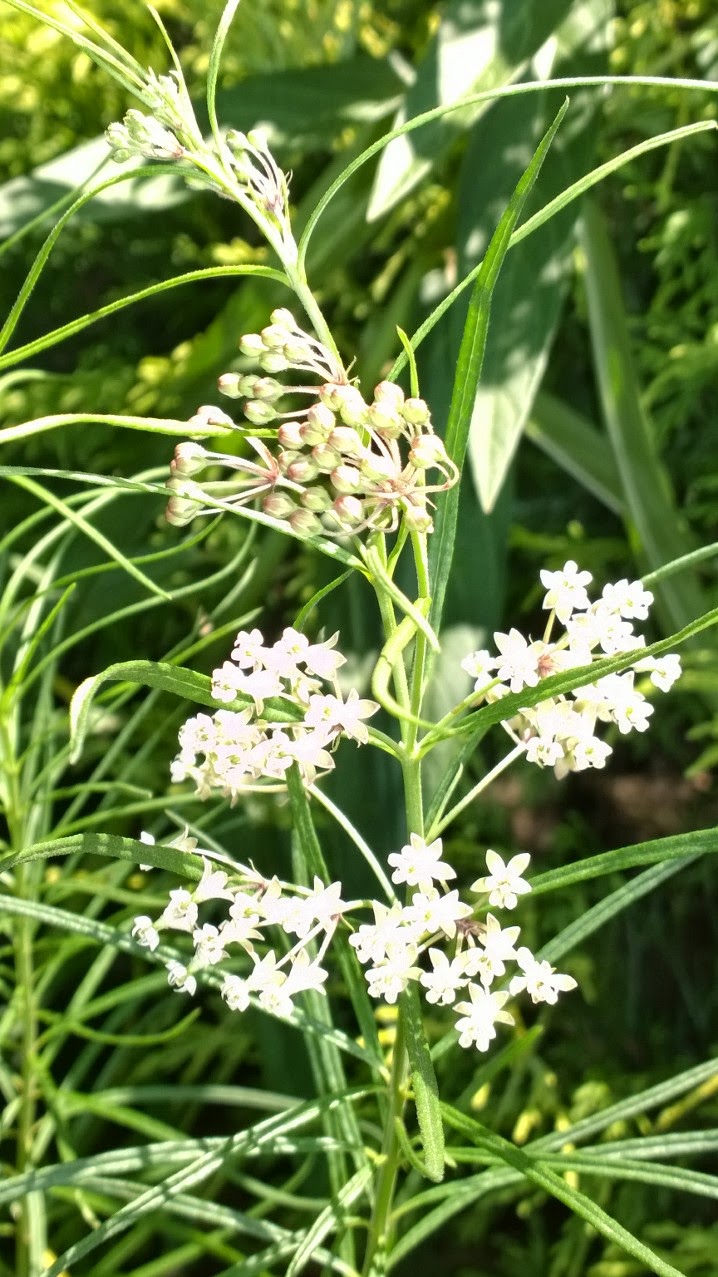
Blunt Leaf Milkweed in Egg Harbor TWP
 In the past I have tried to grow, but was unsuccessful, Asclepias amplexicaulis, ( Blunt Leaf Milkweed), not as common, but not rare. This year, I am happy to report that it did germinate and as of today there are twelve seedlings in the tray and I hope for many more. This plant is growing on my brother's property in Dorothy so it is a local Atlantic County eco-type.  I did sew the Swamps quite heavily and they have germinated and are growing rapidly. I potted up two trays today to have ready for the Earth Day festival at ACUA. I am hoping to have the Common as well, as they sprouted right behind them. The Butterflyweed are coming along a bit more slowly, but they are germinated. I doubt they will be ready for Earth Day, but should be ready by late May. The great thing about Milkweeds is that once potted up, they grow quickly.

If you are looking for Milkweeds, I am planning on bringing extra to the festival this year so I don't run out.  Also I will be giving a talk on Pollinators at 1pm. If you come to my talk I will give you a coupon for a free pack of Common Milkweed seeds with any purchase of 3 or more native plants of any species. I will also be bringing Asters and Seaside Goldenrod which is important food for the Monarchs on migration in the fall.

One thing to remember about Milkweeds and Monarchs is that the leaves are much more important than the flowers. So while the flower provides nectar for all butterflies as well as native bees, the leaves are what the Monarch caterpillars consume. Swamp and Common are the best choices here for the sizable leaves they provide.
Swamp Milkweed provides food for
 Bumble Bees as well as Monarchs

What I love about the Swamps is the beautiful flowers that attract so many pollinators especially Bumble bees. Bumble bees are in trouble as much or more even than honey bees. So in addition to helping Monarchs, you can help the Bumble Bees as well.  I will be talking about that at my presentation. Hope to see you  there.


Tuesday, March 31, 2015

Early Signs of Spring

The calendar says Spring has arrived 10 days ago, but it sure doesn't feel that way. With night time temperatures still in the 20s some nights, it almost feels hopeless. Yet, plants are slowly emerging from the ground, showing greenery even if they do nothing more than just sprout. Aside from that, there are other telltale signs. Today while working on trays in my little unheated greenhouse it warmed up to nearly 70 degrees inside. That felt nice. Earlier in the week on warmer nights I heard the Spring Peepers. Just yesterday morning, I saw my first Bluebird and flock of Pine Warblers for this year. So birds are singing  and on the move, frogs are emerging, along with the Daffodils. Daylight in the early evening. All good signs. I am hoping to see the return of "Rana" my resident Green Frog from last year. She is quite a ham and doesn't mind my getting close to photograph her. She is just adorable and loves to hang out in the bog and nursery pots.
Rana, playing peekaboo.

I am surveying the property to see where I would like to expand the nursery area. I am hoping to have larger size plants in a few species this year as well as a few shrubs and trees. I plan to expand the pollinator garden and install Bluebird nest boxes. There is much work to be done, but I am up to it. Now if it would just get warm......

Update 4/6/2015: I saw my first Mourning Cloak in the back yard yesterday. There was one in the same vicinity last year as well, so I am thinking they may have a favored hibernation spot here.

Sunday, March 8, 2015

Its 2015. Can We Get Some Spring Please?


My pollinator garden, installed in July 2014

Having just been assaulted by another seven inches of snow, I am wondering if spring will ever get here. With so much cold and frozen terrain, it can be hard to see the light at the end of the tunnel. I am so tired of winter right now. But spring will come; it always does. And not a moment too soon.

So I am thinking about what I will be focusing on the for coming year and what I really feel is important is to focus on pollinators. My impromptu pollinator garden on my new property was surprisingly successful last year, having only been installed in July. By August, it was well grown and teeming with bees, wasps, skippers and butterflies and a female hummingbird. I look forward to an even larger area this year as I spent last fall adding to it. This year I plan to finish it with a salt marsh garden. I also began working on the moon garden not too far from it. I am hoping to complete the moon garden this year as well as add on to the organic food garden. 

Looking forward for the year, Monarchs will continue to be a primary area of my focus, but I am also looking to help folks understand the importance of our local native bees. These bees are primary pollinators of our food gardens so for those of us who like to grow some veggies, it is essential that we ensure we have proper habitat for the bees who will do the work for us. I have been reading the book "Attracting Native Pollinators" put out by the Xerces Society. It contains great information on the life cycles, habitat needs and behavior of pollinators. I plan to be doing some workshops based on what I have learned in this text.

I am planning on trying to offer more species of Milkweeds this year as well, including Blunt Leaf Milkweed. In the past I have not had success germinating them, but trying again this year. This looks much like Common Milkweed, only has curly leaves, and shorter. One benefit is that it doesn't spread as much as Common, so it shouldn't be running to the neighbor's yards. I am planning to plant a patch on the back of my property near the border. I have read some articles discouraging the use of Tropical Milkweed, with two reasons cited. One is that it can harbor parasites and second, that the Monarchs tend to love it so much, they don't leave for Mexico in time. So I will continue to check this news and update anything I see.


Pollinator on a Sunflower that grew
from seed from a bird feeder
I am also looking to plant sunflowers this year as I had one come up last year from a feeder seed, which the goldfinches went wild over. But before the seeds were ready, it was enjoyed by many different pollinators. I highly recommend sunflowers in the garden including the annual ones. Last year    the Atlantic City Expressway did a Sunflower wild area that was full of mixed sunflower species. It was beautiful and I always saw goldfinches around it.


So in addition to running the nursery this year, I have a lot on my plate to get my yard more pollinator friendly. All I need is a change in the weather. As I write this, it is time to "spring forward" and move the clocks ahead tonight. That is encouraging. Spring is just around the corner....I just know it.

Tuesday, September 9, 2014

August 2014 Plant of the month New York Ironweed, Vernonia noveboracensis


I first saw New York Ironweed along Absecon Creek and recognized it from a field guide. I had been exploring a roadside brackish marsh which was teaming with flowering natives. I later discovered it along the Great Egg Harbor and two years ago again on the Mullica. I was awed by how tall it was and the rich dark purple flowers, I suppose you could nick name it "Deep Purple."


In the asteracae family, its 3" - 5" flat cluster flower heads attract many kinds of pollinators including birds, bees, butterflies and skippers. The plant can grow from 3 to 7 feet high and tolerate a variety of soils. The fact that I have seen it along coastal rivers indicates that it tolerates brackish conditions. I have also seen it on display at the Pinelands Preservation Alliance's native Plant garden under dryer conditions and it seemed to do well. But I think it is most content to be in moist, sunny areas. I have seen it blooming in the various locations throughout the month of August.


A mass planting in a garden

I have grown this plant from seed with mixed success. Some years I have had an abundant crop, other years it was scarce. I have experimented with cuttings also, and have found mixed results. I prefer seed propagation over cuttings, since I have found that the can bloom the first year from seed if given room to grow and plenty of sun and water.


Try this plant for back of the border where you want something tall. I blends well with companion plants, Cardinal Flower, Sneezeweed, Narrow Leaf Sunflower and Marsh Rattlesnake Master which make for a colorful display. In a moist, sunny location you should have beautiful results.

Sunday, August 3, 2014

Insect Rants and Raves

Whorled Milkweed
I am going to stray from the plants today to talk about insects, particularly pollinators which, as we all know the plants depend on for survival and so do we. Two of these topics I am very excited about and one I am appalled at.


On July 5th I saw my first Monarch of 2014. I will be watching for more. I also saw a few out at Forsythe Wildlife Refuge. I hope you are all finding them as well. I have had a lot of calls for Milkweed, so the word is definitely getting out there to help protect them and that is great. Hopefully we will start to see an increase rather then an decrease in populations. I do have a few more plants available if anyone is looking for some. Common, Swamp and Butterfly. 


While I am on the Milkweed subject, I am happy to report that my first seed-grown Whorled Milkweed has finally bloomed after three years. I am very excited to finally have a picture. It is quite dainty and has white flowers. I look forward to harvesting seed this year and having them available next year.


Anyone who knows me well knows that my second love after photographing plants is photographing dragonflies. I love dragonflies. This year in my new home I have a resident male Great Blue Skimmer who is perched on a mini-shepherd's hook daily for over a month and patrols the yard chasing off all other dragonflies, hummingbirds and pickup trucks who approach his area. I call him Jagoo, the Urdu for for fighter. He is not shy at all and lets me take his picture quite close up. He is quite a joy and greets me each sunny morning when I come outside as he has gotten used to me and knows I am not a threat. He seems to stay away when it is overcast.  Another dragonfly that hangs out on the other side of the yard away from Jagoo, is a male Painted Skimmer. He has been quite shy, but today allowed me to photograph him up close, close enough where I could almost touch him. So I am quite excited to get these close up shots of both of them.

Jagoo, Great Blue Skimmer,
 (and watch-dragonfly)
Male Painted Skimmer


                                                         Lastly, I have a concern. I was surfing the net and clicked on an ad entitled "How to Green Your Home" which turned out to be an add for Gaiam. Now I love Gaiam and have ordered a few things for my new home from them. They are generally an eco-friendly, fair trade oriented, green company. However one of the items in the ad was recycled glass wasp traps. Now something about this title just doesn't sound right to me. Am I to pay up for something "green" to kill a pollinator? I was somewhat appalled.


Wasp nectaring on a Swamp Milkweed

Now I realize that wasps can be a problem when they build their homes under the eaves and around areas used by humans. But I am inclined to believe that humans can find a way to live in harmony with wasps by encouraging them to build their nests away from our living areas by installing a fake nest or using a wasp repellent. Avoid having things they consider food like pet food and compost piles near the living area. Perhaps planting nectar plants out in the back areas to entice them out there. I will look into more ways to discourage wasps. But as I have seen them pollinating my vegetable garden and Swamp Milkweeds, as well as carrying off detrimental caterpillars like Tomato Hornworm, I certainly welcome mine. I will post anything I find related to this, but encourage you to share any tips you have for non-lethal wasp control. After all, they are pollinators.

Friday, July 4, 2014

Native Plant of the Month - July 2014 Spotted Wintergreen - Chimaphila maculata

I have to say that one of my all time favorite plants since I was small has been Spotted Wintergreen. When I was ten years old we moved from the bayside of Absecon to the Estates when the terrain begins to change and borders on the Pinelands. Our yard was wooded with lots of trees and behind our property was woods for as far as the eye could see. It was completely different from what we had before and I instantly fell in love with the woods. I would walk the trails behind our house and go out on Saturdays exploring. It was along one of the trails that I first spotted the tiny plant, dark green with whites stripes down its leaves. I didn't know the name of it, though a friend had told me it was "Teaberry". I later found that to be incorrect when I did learn the identity of the plant, finding it in a book. It was Spotted Wintergreen, Chimaphila maculata. This plant almost seemed magical to me, staying green all winter when everything else lost its leaves.

It wasn't until I was much older that I saw the plant flower, small flowers turned upside down like little umbrellas, creamy white and waxy, with green centers. Still it was enchanting to me. Unfortunately the woods I grew up in were later converted to suburbia with McMansions. My sister bought a lot there saying it would be nice to live where you played as a child. She was getting ready to put in a swimming pool and I went to survey the yard for plants to rescue and found a small population. I carefully dug them with about two feet of soil trying to capture the the soil fungus that the plant needs and hoped they would survive in my yard which was quite natural. Eventually they seemed to sucumb and disappeared. Then for about two years I didn't rake the flower beds opting to leave the leaves in place to act as mulch for my azaleas. One spring I was cleaning up and lo and behold, the plant was there under the azalea. I can only guess that the leaf compost created the environment for the fungus to thrive and the plant to re-emerged from a dormant state which they sometimes do when conditions are not right for them to thrive in. On my new property I am very blessed to have several populations. One is quite beautiful and large and seem to be growing where the previous owner blew the leaves to.

I have not attempted to propagate and sell this plant as it tends to just grow where it will. Since there is a fungal association with this plant so it will grow where conditons are met. I believe however that the mix of pine/oak leaf litter plays a role in the availablilty of the needed fungus. Knowing this I recommend just enjoying the plant where you see it and resist the temptation to buy from diggers or dig one yourself. You can always visit the populations yearly when they bloom. I often revisit my favorite plants in the wild each year and even today when I happen upon populations of this precious little plant, it brings an instant sense of happiness and joy to me.


HAPPY FOURTH OF JULY  2014