Wednesday, September 16, 2015

Milkweed for Monarchs at September Meeting of NJ Native Plant Society Southeast


Come on out to see Pat Sutton, a great and accomplished expert. There will be a book singing as well. I know Pat and she is very dedicated to helping the Monarchs out. You won't want to miss this.


null 
Native Plants Society 
of New Jersey
Southeast Chapter  
Our September Meeting
The Southeast Chapter of the Native Plant Society of New Jersey

Reminder: Our September Meeting
 
The next meeting of our Southeast Chapter will begin promptly at 7 p.m. Monday, September 21, 2015, in room C-134 at Stockton University.  
 
"Milkweeds for Monarchs" a program & book signing by Pat Sutton.  Monarch butterflies make the most amazing migration of any insect in the world.  Join Pat to learn all about their life cycle and journey from Mexico to the U.S. and Canada, and back to Mexico for the winter months.  Their future depends on healthy milkweed stands here in the U.S. where their numbers multiply (spring through fall).  There are many different and beautiful native milkweeds that you can plant in your own garden or in community gardens to help create a path of milkweed from Mexico to Canada that will benefit monarchs.  Plant it and they will come!  Don't plant it and someday they may not come.
 
Pat Sutton  has studied the natural world for over 30 years, as the naturalist at the Cape May Point State Park in the 1970s and 1980s and then for 21 years as the naturalist and program director at the Cape May Bird Observatory.  Today Pat is a free-lance writer, photographer, educator, lecturer, tour leader, and wildlife garden consultant.  For more information go to Pat and Clay's website: www.patandclaysutton.com
 
Directions to C-134:
 
To reach C-134:  Park in Parking Lot #1 or #2 and bear right walking down the hill, following the signs to Alton Auditorium. Enter the A-D Building by the main doors (will be on your left, across from the Arts & Sciences Building). Go upstairs one flight:  C-wing will be on your right, halfway down the hallway.  C-134 is at the far right end of C-wing.  Alternative (slightly longer) Route: Park in Parking Lots #3 or #4 and walk through the Campus Center Building, then bear right as you exit.  Go down the hill and enter the A-D building on your left and turn right as you enter.   Go upstairs one flight:  C-wing will be on your left, halfway down the hallway; C-134 is at the far right end of C-wing. 
 
If you would like to be updated with details about our future meetings, please contact Jesse Connor at:  southeast@npsnj.org.  (Contacting this site will put you on the list for monthly meeting information, field trip info, and timely updates.)
 
Jesse Connor, Jack Connor, Barbara Fiedler, and Jean Riling
 
For more information contact

Activities like this are made possible through your membership. Thank you for becoming a member of the NPSNJ.
STAY CONNECTED:
Forward this email


This email was sent to cudabird88@aol.com by southeast@npsnj.org |  


Native Plant Society of New Jersey - DelBay Chapter | 135 N High Street | Millville | NJ | 08332

Sunday, July 12, 2015

2015 Botany Adventures - scroll down for later dates

Virginia Meadow Beauty and Cranberries
12 JUL 15 - Gravelly Run... Mays Landing, NJ

 This year has been so busy and hectic, I haven't even been out botanizing yet and its mid July. Today that changed and I took a trip to nearby Gravelly Run in Mays Landing, NJ. I remember the place from when I was a kid, but have not been there since. Today the natural area is owned by the NJ Land trust and an adjacent part by the Atlantic County Parks System. It is a beautiful place to see, even as parts are strewn with litter and trash which is truly a shame. Other than that it looks almost pristine. The Gravelly Run Branch leads into the Great Egg Harbor River which has a Wild and Scenic designation. I made my way back on foot and took a little over an hour to explore.  The forest has quite a few Hickory trees in addition to the more common pines and oaks. I found a nice little population of cranberries and other common bog plants like Virginia Meadow Beauty which was blooming, Marsh St. John's Wort, Highbush Blueberry. The terrain seemed to switch quickly however to upland with Sweetfern and Yellow Wild Indigo.


Cedar Forest
 Shortly though, it became wet again as I entered a Atlantic White Cedar Forest where I saw Ground Pine and Sphagnum Mosses. Cedar Forests always felt magical and enchanting to me and I attribute this to the tall tree trunks, the green mossy banks, dappled shade and the sound of rushing water. There were some bright red fungi growing out of the Sphagnum moss. But what really makes them feel alive is when the "fairies" are around. By fairies, I mean the Ebony Jewelwing damselflies that flutter all about with their beautiful iridescent bodies and black wings. There were many today and I watched them flutter about. Unfortunately one got stuck in a spider web, a reminder that nature is not always beautiful, but that is well designed. The spider came running to it and immediately began encasing him for a meal.

A friendly Ebony Jewelwing
And while I have found most Ebony Jewelwings to be camera shy, one little guy was quite intrigued with me. He allowed me to get close and photograph him repeatedly and even twice landed on my hand and checked me out. That was a first. We stared at each other eye to eye. He did not seem afraid. He even allowed me to film him eating a small bug he caught. When I was done with the photo shoot, he turned his head as I moved past him and watched me go.

Wild Blueberries

Litter at an obvious party spot
As I came upon another pond, I found a Highbush Blueberry bush covered in berries. I tried them and they were delicious. I saw a beautiful lavender colored Damselfly. Birds sang in the trees and numerous frogs jumped into the pond as I walked around it. The pond appeared bluish, indicative of cyanobacteria. A tree ladder had been built with a rope for swinging out; it was obviously a popular swimming hole at one time. Sadly it was used by partygoers who didn't see fit to take their trash with them and bottles, cans and other trash were found in piles. It hurts to see such a disrespect for this place. But I know that the Land Trust does do cleanups so it will get cleaned up eventually.

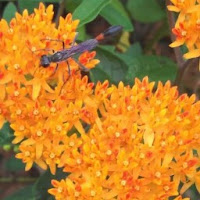
Butterflyweed with Thread-waisted Wasp


I was glad to finally get back there. On my way back to the car on the roadside, I found a nice Butterflyweed blooming with several pollinators on it including a Thread-waisted Wasp. They place felt very alive and I felt recharged after my visit. It was great to get out exploring. I am hoping to do more soon and will be happy to share my experiences.

-------------------------------------------------------------------------------------------

23 AUG 15 - Tuckahoe WMA, Corbin City/Tuckahoe, NJ
This WMA is located on the county line and straddles it with entrances in both Atlantic and Cape May counties

I have been growing the perennial native sunflower, Helianthus angustifolius for several years now. This year, I tried and was thankfully successful in growing Helianthus giganteus, which is currently blooming, (first year, yay!) I have been looking for a Helianthus divaricatus, as the only plants I knew of were destroyed or stolen before I could obtain seeds. Then I learned there were two other Helianthus species in Atlantic County so I decided to go looking for whatever I could find, in particular Helianthus mollis. I had read about it being a plant found in dry soils and had heard that the Tuckahoe WMA was a good place to find that kind of habitat. So off I went to the WMA in search of Helianthus and looking forward to exploring a place I had never been to. The place is so big it took me two days to get around it. It reminded me a lot or Brigantine (Forsythe) Wildlife Refuge as there were long gravel trails to drive out in the salt marshes. I never did find what I was looking for, but I did find a lot of plants I had never heard of, which gave me plenty of homework when I got home keying these out to learn what they were. They were all huge grasses, some 12 ft. high.  Here are my new finds I am happy to share:


Big Cord Grass, Spartina cynosuroides.
 This one attracted me not only with size, but its odd seed heads. This is a perennial, long lived plant that spreads mainly by rhizomes and reaches a mature height of 8 ft.


Coastal or Bitter Panic grass, Panicum amarum.  I had seen this before on restored beach projects, but had never actually seen one where nature put it. This rather common Panicum, is very similar to its close relative Panicum virgatum, Switchgrass, but is found on beaches and salt marsh edges. It has a bluish tinge to it and a fountain-like form rather than erect, making it appear quite wide. It was a beautiful grass and I would love to try growing it.

Indian Grass, Sorghastrum nutans. I have grown this species in the past, but never have I seen such fine specimens as the ones growing here. It also appeared a little bluish. They appear to be mildly salt tolerant and quite fond of the rich organic matter and more neutral pH the tidal marsh provides.


Giant Bristlegrass, Sentaria magna. This one really caught me by surprise. Not only had I not seen it in the wild, I had never read about it in any of my five salt marsh books. Yet here it was this huge plant towering way above the Phragmites and all other plants, looking like a Foxtail Millet on steroids. The bristle seed head itself was 1 1/2 ft.  with huge, wide leaves resembling that of corn, but having a characteristic light line down the center. I was truly awed by this one. This plant grows from NJ to Florida, however is rather local in populations. It is also an annual like our Wild Rice.

So my quest for sunflowers turned out to be a self study crash course in native grasses, but oh the serendipity of it. I did find one sunflower growing out there, but haven't yet made a positive determination as to which one it is. As I headed out the sun was beginning to set, reminding me of how much the days are getting shorter. It was a beautiful sight, and I highly recommend this WMA as a place to visit. I hope to return soon.




Wednesday, June 10, 2015

Dr. Dan Duran Talks About Native Plants for Food 6/15/15

Here is an announcement from the South East Chapter of the Native Plant Society of NJ for the June meeting which will feature Dr. Dan Duran as the Speaker on growing native plants for food.

-------------------------------------------------------------------------------------------

MONDAY, June 15, 2015, 7:00 PM

We are excited about our local NPSNJ chapter that serves native plant enthusiasts in Atlantic County and Cape County as well as anyone from areas west or north who would like to join us. We hold eight evening meetings a year on the 3rd Monday of the month (September, October, November, February, March, April, May, and June). We are delighted that Stockton College’s Sustainability Program – specifically the Campus Farm Native Plant Project – is sponsoring us and making it possible for us to have meetings in an easily-accessible location and a comfortable setting with the necessary “smart room” equipment.

Our June meeting will begin promptly at 7 p.m. Monday, June 15, 2015, in room B-012 at the Richard Stockton College of New Jersey.

Gardening with Native Plants for Food by Daniel Duran

Native plants can be used to improve the ecological value of our landscapes in a variety of ways. One potential benefit that most of us have never considered is the use of our native flora for food.  Dr. Duran will discuss how we can integrate this newly-recognized approach to promoting sustainability into our fruit and vegetable gardens. 

We welcome Dan Duran back to Stockton College where he received a BS in Environmental Sciences. Dan is currently an assistant professor at Drexel University where he teaches a course on Native Plants and Sustainability. He is also adjunct faculty member at the Barnes Foundation Arboretum.

If you would like to be updated with details about our future meetings, please contact Jesse Connor at:  southeast@npsnj.org.  (Contacting this site will put you on the list for monthly meeting information, field trip info, and timely updates.)

Directions to B 012:   Easiest:  park in Parking Lot #1 or #2 and bear right walking down the hill, following the signs to Alton Auditorium. Enter the A-D Building by the main doors across from the Arts & Sciences Building. B-012 is on the ground floor.   Second-Best Route: Park in Parking Lots #3 or #4 and walk through the Campus Center Building, then bear right as you exit.  Go down the hill and enter the A-D building on your left and turn right as you enter.  

We look forward to seeing you there

Jesse Connor, Jack Connor, Barbara Fiedler, and Jean Riling

For more information, contact Jesse Connor, Jack Connor, or Barbara Fiedler at email: southeast@npsnj.org

Thursday, June 4, 2015

Native Plant Sale at the Absecon City-wide Yard sale event. 6/6/15


I will be selling my organic native plants at the Absecon city-wide yard sale, this coming Saturday 6/6/15. As the weather has been quite cool lately, it looks like its still a good time to plant. In addition to plants there will be yard sale items from my family members and lots of other sales nearby if you like yard-sailing, as I call it. Below is a list of what I plan to bring as well as some pictures of  milkweeds as well as plants I am carrying for the first time, Giant Swamp Sunflower, and Sticky Catchfly. And I will bring plenty of Milkweed.

The sale will be held at 703 Ambassador Dr, Absecon, NJ 08201 from 8-4pm on Saturday, 6/6/15. Raindate is Sunday.

Sticky Catchfly
Giant Swamp Sunflower
     
Butterflyweed                 
Swamp Milkweed

Bee Balm
 

Aster novae-angliae - New England Aster

Aster laevis - Smooth Blue Aster

Liatris spicata - Blazing Star

Solidago sempervirens - Seaside Goldenrod

Echinacea purpurea - Purple Coneflower

Helianthus giganteus - Giant Sunflower new 2015

Oenthera fruticosa - Sundrops

Panicum virgatum - Switchgrass

Typha angustifolius - Cattails new 2015

Seashore Mallow

Eupatorium perfoliatum - Boneset

Phlox stolonifera - Creeping Phlox

Silene caroliniana - Sticky Catchfly New 2015

Sedum ternatum - Wild Stonecrop

Lysimachia ciliata - Purple Fringed Loosestrife

Asclepias incarnata - Swamp Milkweed

Prickly Pear Cactus, Opuntia humifusa

Butterflyweed - Asclepias tuberosa

The address is 703 Ambassador Drive Absecon, NJ 08201 which is located in Absecon Estates behind the Shoprite and City Hall/Heritage Park.

Organic vegetable plants will also be available for $1.00 each. 6 pk for $4.00 each. Jalapenos, Lettuce, Scallions, Cilantro, Beefsteak tomatoes, Basil, these are nice size plants, no chemicals.

There will also be household goods for sale, from 2 -3 families.

The weather looks like its going to be splendid, so come on out and find bargains city-wide.


Friday, May 29, 2015

May 2015 Native Plant of the Month - Pink Ladies Slipper (Cypripedium acaule)


As a young girl, I grew up on the edge of the woods. Each summer when school let out I set about the woods behind our yard exploring all there was to see. As an avid gardener even then, there were woodland flowers I grew to love and was fascinated with. One of these was the Pink Lady's Slipper,Cypripedium acaule. It is also known as Moccasin Flower. There was even one growing in our yard for a few years before it disappeared. I also had one at the mobile home for a while and on the grounds of the park there was a wooded area with a nice population along a trail. Now on my new property I have counted 30 so far this year. Some are solitary, others are in larger populations of different ages. The flowering ones are all beautiful this year and I feel blessed they have made there home here. So I have chosen this plant to talk about this month as its mere existence is a perfect example of nature in harmony as it relies on other organisms for survival.

  Sadly I have heard many tales about folks who dug them up from the woods, but the plants did not survive. It is nearly impossible to transplant. I have learned it is better enjoyed where it chooses to show up. The conditions required for it to grow are quite precise. I do not sell or propagate this plant. But I have learned how to keep them if they are already there.  The key to that is to not rake leaves or needles from the area in which they are growing.

The reason for this is because unlike most seeds, orchid seeds do not contain food supplies to nourish the plant until true leaves are formed. So the plant relies on a soil fungus to obtain food. The threads of the fungus break open the seed and attach to it, passing on food and nutrients to the plant. Once the plant is mature enough to produce its own food, the fungus will obtain its nutrients from the roots of the plant. Thus there is a symbiotic relationship between the two.  This fungus, of the Rhizoctonia genus, is found in leaf litter, so not raking the area where the plants are growing is beneficial to both plant and fungus.


 Another interesting this about this plant is that it requires bees for pollination. The plant gives off a scent pleasant to lure bees.The flower has a slit in the very front where only bees strong enough to enter may do so. Once inside, they slit closes  and the bee is trapped. In order to escape, it must move forward to the only exit at the top of the flower. Along the way there are hairs that guide the bee and lead it to the opening, but not until it passes under the stigmas, picking up pollen on its body. When it enters a new flower, that pollen makes contact with stigmas in the next plant and pollination has occurred. At that point, the bee is near the exit and makes its escape. Sounds like something from a movie, right? Truly fascinating.
Lady's Slipper grows 6 to 15 inches tall.The plant consists of only two basal opposite leaves. They are hairy with pronounced veins. The flower stalk is separate with no leaves. At the top is a single flower with a pink pouch that resemble a moccasin or slipper. The pouch contains the slit and may have a darker pink venation which helps guide the bee to the opening. At the top of the flower is another opening from which the bee will exit.

It takes many years for a new plant to flower. In its early years it may be just a leaf or two.  However the plant can live up to 20 years in the wild. So if you are out for a walk in the woods in May or early June, be sure to keep an eye out for this little beauty. If you spot one, it just may become a new friend to go and visit each year.


Thursday, May 7, 2015

7th Annual UU Native Plant Swap and Sale May 9th

The 7th annual UU Native Plant Swap and Sale will be help this Saturday, May 9th from 9-2 at the UU Center on the corner of Liebig and Pomona Rds. This event just gets better with age like wine. Native plant enthusiasts bring their extra "volunteer" native plants to exchange for others. Here's how it works: the first two plants cover the price of admission, then for each additional plant you get a ticket to turn in for another. You go about the tables, adding plants to your tray. Then go to the checkout and "pay" for the plants with your tickets. There is a limit of ten tickets per person, but you can also buy additional plants from the tables. I recommend bringing 12 plants so you can get 10 tickets.

Also I have a table there with my plants for sale as a fundraiser I do each year for the congregation. Plants at my table are $4.75 each including tax. With any purchase of 5 or more plants, you get a free packet of Common Milkweed seeds.

Here is a list of what I will be bringing:

Boneset
Blue Vervain                                                    
Turtlehead
Sundrops
Swamp Milkweed (limited)
Columbine
Liatris
Orange Coneflower
Purple Coneflower

Cattails
Seashore Mallow
Seaside Goldenrod 
Prickly Pear
Little Bluestem
Switch Grass
Butterflyweed
Blue Eyed Grass
Sticky Catchfly
Creeping Phlox
Wild Stonecrop

As always advice is free, and myself, Jesse and Barbara are always happy to give it. So come on out and support this great cause. Pick up something for Mother's Day. Proceeds go to the center, a beautiful GREEN building. You can also see the native plant gardens on the site, maintained by members of the congregation. Hope to see you there.

Friday, April 24, 2015

Come Celebrate Earth Day at ACUA's 25th Anual Earth Day Festival April 26 10am-4pm

This year is a milestone for ACUA's annual Earth Day Festival. The event has been held for 25 years in April rain or shine. I have always loved the festival. I used to attend it with my grandmother back in my younger days. It was here that I first met Howard Boyd, author of "Wildflowers of the Pine Barrens of New Jersey", which I purchased from him and he signed the copy for me. I became a vendor when I started raising native plants in 2005. For several years I have done workshops on native plants and will be again this year, only with a different touch. I will be talking about native plants for pollinators. Because our pollinators are declining, I felt it was important to talk about how we can use native plants to help sustain them.

I usually include a handout with  coupon good at my table. This year the coupon will be for a packet of Common Milkweed seeds. Milkweed is the only larval host plant for Monarch butterflies. I will also be selling Swamp Milkweed.

I will also have the following plants available: 
Blazing Star
Turtlehead
Eastern Columbine
Common Milkweed
Boneset
Smooth Blue Aster
Maryland Golden Aster
Silene caroliniana, Sticky Catchfly
New England Aster
Orange Coneflower
Narrow Leaved Cattail
Sneezeweed
Slender Blue Flag
Goat's Beard
Creeping Phlox
Sticky Catchfly
Wild Stonecrop

The Sticky Catchfly is a new one I am carrying this year. I bought my first one at Bowman's Hill. I love this little plant as it is small for the front of the border, early and a long bloomer. It makes a nice splash of pink in a rock garden. I was able to source some so I will have it available for sale.

Hopefully the weather will be nice, not too hot or cold. But the festival goes in all kinds of weather so come on out and hear why our native bees are so important and how you can help them thrive. There will also be other workshops of interest like organic gardening, permaculture, backyard chickens and rain barrels as well as local environmental organizations, live music and good food. Check this Twitter hashtag to see more info. #ACUAEarthDay.  Hope to see you there.
